-
Email info@annnutr.org
-
Address 848 N. Rainbow Blvd. #5486 Las Vegas, NV 89107, USA
Department of Life Sciences, Sharda School of Bioscience and Technology, Sharda University, India.
*Corresponding author: Saleem Siddiqui
Department of Life Sciences, Sharda School of Bioscience and Technology, Sharda University, Greater Noida-201310,Uttar Pradesh, India.
Email ID: saleemcfst@gmail.com; saleem.siddiqui@sharda.ac.in
Received: Dec 09, 2025
Accepted: Feb 04, 2026
Published Online: Feb 11, 2026
Journal: Annals of Nutrition and Dietetics
Copyright: Siddiqui S et al. © All rights are reserved Publication Model: Open Access
Citation: Sharma S, Maurya N, Siddiqui S. Antimicrobial activity of marigold (Tagetes erecta) flowers: Influence of drying methods and extraction techniques. Ann Nutr Diet. 2026; 2(1): 1007.
Background and aim: The present investigation was conducted with the aim to identify the most appropriate technique to dry the petals of marigold flowers and then to extract from them the active phyto-constituents by different methods, in order to obtain maximum antibacterial activity against typical Gram-positive and Gram-negative bacteria.
Methods: African marigold (Tagetes erecta) petals were separated and dried by 5 different methods, viz., air drying, oven drying, fluidized bed drying, freeze drying, and vacuum oven drying. This research assessed the antibacterial activity of marigold flower extracts obtained from these differently dried petals using two extraction methods, viz., petroleum ether-based Soxhlet extraction, and edible oil–based extraction (sunflower, olive, and corn oils). The extracts were evaluated against Escherichia coli, Pseudomonas aeruginosa, & Staphylococcus aureus using the agar well diffusion assay.
Results: Petroleum ether extracts exhibited negligible inhibition, but oil-based extracts revealed considerable and persistent antibacterial effects. Marigold extracts from Freeze Dried (FD) petals showed highest inhibition zones across all bacterial strains, with corn oil extract having the maximum effectiveness, notably against E. coli (8.1 mm). Minimum Inhibitory Concentration (MIC) assessment indicated a concentration-dependent antibacterial effect, with maximum inhibition observed at 75 µg/ml. Extracts obtained from the freeze-dried petals showed the highest zone of inhibition against the test microorganisms.
Keywords: Antibacterial activity; Drying methods; Marigold flower extract; Oil based extraction; Petroleum ether based extraction.
According to the World Health Organization (WHO), antimicrobial resistance is regarded as one of the top ten global health problems. The growth of antimicrobial resistance may be attributed to the overuse and abuse of antibiotics. Antimicrobial resistance is another factor contributing to the diminished efficacy of certain antibacterial drugs [1]. The diminished efficacy of several traditional antibacterial agents increases this issue, reducing therapeutic alternatives for infectious disorders. In addition to human health, microbial contamination and deterioration represent a significant threat to food systems [2].
All food product categories are greatly impacted by microbialinduced food degradation, which also causes major waste and losses even in industrialized nations. It is estimated that microbial spoiling causes around 40% of worldwide food losses each year [3].
Nature is the source of medicinal compounds, which have been utilized for centuries. Numbers of modern drugs have been derived from natural sources [4]. Phytochemicals derived from plant sources, including stem, leaf, flower, fruit, and seed waste have been studied for their significant bioactive molecules. Plants contain a diverse array of secondary metabolites, including tannins, terpenoids, alkaloids, flavonoids, and glycosides, which have demonstrated antimicrobial properties [5,6]. These approaches maximize the recovery of bioactive contents from plant matrices and, minimize losses during extraction application in functional food and nutraceutical production. Flower petals serve as a significant source of various polyphenols.
African Marigold (Tagetes erecta), belonging to the Asteraceae family. Marigold flowers are connected to festive occasions, marriages, religious rituals, and social functions. The flowers are also used as a stemless cut flower for interior decoration, for decoration of temples and pandals on special occasions, and for decoration of stages in marriages. The shelf life and ornamental value of the marigold flowers, however, is just 3-4 days [7]. A lot of spent flowers after the function are left as waste. Since marigold flowers are a wonderful natural gift with an abundance of nutrients and phytochemicals having food and therapeutic values [8,9], the flowers that remained unsold or after the ceremonies can be dried and utilised for extraction of by-products for various food and medicinal applications. The antibacterial and antifungal properties of marigold flowers have also been reported [10,11].
Drying is an important procedure in the processing of raw materials in order to extend their shelf life, as it prevents enzymatic breakdown and reduces microbial growth [12]. Various drying techniques are widely used in the industry to dry plant materials. A suitable drying technique helps to increase extraction yield and prevent the degradation of extracted phytochemicals, leading to an ability to produce products of higher quality and potency [13,14].
The method of extraction is also known to influence the yield and quality of the extracted phytochemicals [13,15]. The conventional Soxhlet extract method using organic solvents is generally used for extraction of phytochemicals. However, considering the environmental pollution from volatile organic solvents, potential health hazards, and the possibility of solvent residues in the final extract, the alternative environmentally friendly extraction technologies have been explored for food use applications. Extraction by vegetable oils as an alternative green solvent for fat-soluble phytochemicals could be a promising ecofriendly technique, offering additional advantages due to oils’ lipophilic nature and by serving as a protective barrier against oxygen [16].
The present investigation was thus conducted with the aim to identify the most appropriate technique to dry the petals of marigold flowers and then to extract from them the active phyto-constituents by different methods, in order to obtain maximum antibacterial activity against typical Gram-positive and Gram-negative bacteria.
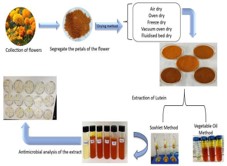
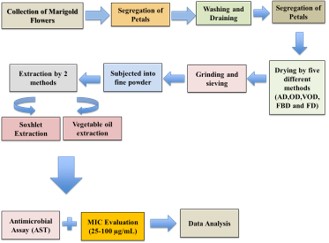
The complete procedure for the conduct of the experiment is illustrated in (Figure 1). The details of the procedure are described below in the subsequent subsections.
Raw material and chemicals
The fresh and full-blown flowers of African marigold (Tagetes erecta L), variety Pusa Narangi Gainda, were purchased from the local market of Greater Noida, Uttar Pradesh, India. The vegetables oils viz., sunflower oil, olive oil, and corn oil of the standard brands were procured from the super store in Greater Noida. The organic solvent petroleum ether and Luria Bertani (LB) agar were obtained from Hi-Media, Mumbai, India.
Drying of marigold flowers
Marigold petals were separated from the flowers and cleaned. Fresh petals were washed with potable water and allowed to drain at room temperature. The cleaned petals were then divided into five lots of 500 g each, and subjected to different drying methods viz., Air Drying (AD) at ambient conditions, Oven Drying (OD) at 40°C, Fluidized Bed Drying (FBD) at 40°C, Freeze Drying (FD) at −40°C, and Vacuum Oven Drying (VOD) at 40°C. After drying, the petals were ground to fine powder using a laboratory grinder. The ground product was sieved through a 60-mesh sieve to ensure uniform particle size. The resultant marigold powder was collected and packed in opaque vacuumsealed bags to prevent exposure to light and air, and stored under refrigerated conditions (4°C) for further use.
Extraction
The powder of dried petals was extracted by Soxhlet extraction, and oil extraction methods. In the conventional Soxhlet extraction method, 0.25 g of dried powder was placed in a Soxhlet apparatus and subjected to extraction with petroleum ether for a duration of 6 h. After the extraction process, the solvent was evaporated to 25 ml by a rotary evaporator to get the concentrated extract. For the vegetable oil extraction method, 0.25 g of dried powder was extracted with 25 ml of the edible oils (corn oil, sunflower oil, or olive oil), and then centrifuged at 5000 rpm for 10 min. The extracts were collected and stored in dark at 4°C in glass vials for further analysis.
Antimicrobial assay for the detection of pathogenicity properties of the marigold extract
The antibacterial assessment involved testing various compounds against specific bacteria, including Staphylococcus aureus, Escherichia coli, and Pseudomonas aeruginosa. The agar well diffusion method used Luria Bertani (LB) agar plates for bacterial testing. Streptomycin served as the standard antibacterial agent for comparison. Media for the antibiotic susceptibility tests were prepared and autoclaved at 121°C for 20 minutes. An eight-hour-old bacterial inoculum with 104 CFU/mL was evenly spread on the surface of the prepared Petri dishes. Sterile gel puncture was used for creating wells in the agar plates, containing 10 µg/ml of the extracts. Petroleum ether, sunflower oil, olive oil, and corn oil acted as respective negative controls for the Antibiotic Susceptibility Test (AST). Standard drugs (streptomycin) were also tested at 10 µg/mL. After placing the discs, the plates were incubated at 37°C for 24 h. The results were determined by measuring the diameter of the inhibition zones.
Evaluation of Minimum Inhibitory Concentration (MIC) of the marigold extract
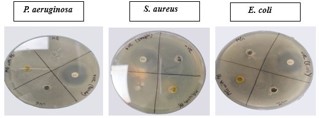
The Minimum Inhibitory Concentration (MIC) of the most effective extract components was assessed using a two-fold serial dilution technique. A stock solution of the test extract (100 µg/mL in ethanol) was serially diluted to achieve four concentrations—25, 50, 75, and 100 µg/mL that has been denoted as A, B, C, and D, respectively. Each dilution was injected with the reactivated bacterial cultures and incubated at 37°C for 24 h. Further to incubation, antibacterial efficacy was evaluated by determining the diameter of the inhibitory zones. The MIC values, indicating the minimum concentration that may prevent apparent bacterial growth was recorded.
Antimicrobial efficacy of marigold extracts
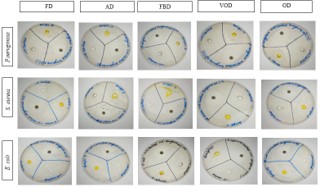
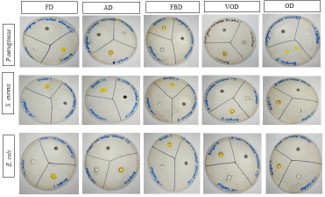
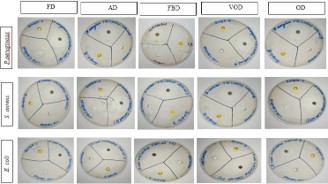
The antimicrobial efficacy of marigold extracts obtained using various solvents (petroleum ether, sunflower oil, olive oil, and corn oil) and drying techniques (Freeze Drying—FD, Air Drying—AD, Fluidized Bed Drying—FBD, Vacuum Oven Drying— VOD, and Oven Drying—OD) were evaluated against Escherichia coli, Pseudomonas aeruginosa, and Staphylococcus aureus using the agar diffusion method, and the results are presented in (Table 1) and supplementary (Figures 1-3). Streptomycin displayed the largest zones of inhibition (10.0-15.0 mm), indicating assay validity, whilst negative controls (solvents alone and corn oil) showed no inhibition, which indicated that the antibacterial action was primarily related to marigold bioactive components.
| Microorganisms | Standard (Streptomycin) | FD | AD | FBD | VOD | OD | |
|---|---|---|---|---|---|---|---|
| Petroleum ether | E. coli | 14.0±0.12 | 7.0±0.18 | 5.5±0.21 | 5.5±0.20 | 6.5±0.19 | 5.4±0.22 |
| P. aeruginosa | 10.0±0.10 | 6.5±0.17 | 5.0±0.19 | 5.0±0.18 | 5.0±0.20 | 5.0±0.21 | |
| S. aureus | 12.0±0.11 | 7.5±0.22 | 5.0±0.20 | 5.0±0.19 | 5.0±0.21 | 6.5±0.18 | |
| Sunflower oil | E. coli | 14.0±0.12 | 7.1±0.15 | 5.0±0.18 | 5.1±0.16 | 5.5±0.17 | 5.1±0.19 |
| P. aeruginosa | 10.0±0.10 | 6.5±0.14 | 5.0±0.17 | 5.1±0.15 | 5.3±0.16 | 5.4±0.18 | |
| S. aureus | 12.0±0.11 | 6.5±0.16 | 6.5±0.18 | 5.5±0.17 | 5.2±0.16 | 5.1±0.19 | |
| Olive oil | E. coli | 14.0±0.12 | 6.5±0.17 | 5.0±0.18 | 5.5±0.19 | 5.0±0.16 | 5.0±0.21 |
| P. aeruginosa | 10.0±0.10 | 7.1±0.15 | 5.5±0.17 | 5.1±0.16 | 5.3±0.18 | 5.3±0.17 | |
| S. aureus | 12.0±0.11 | 7.3±0.18 | 5.0±0.20 | 6.3±0.17 | 5.0±0.19 | 5.4±0.16 | |
| Corn oil | E. coli | 14.0±0.12 | 8.1±0.20 | 5.2±0.19 | 5.5±0.18 | 5.6±0.17 | 5.4±0.21 |
| P. aeruginosa | 10.0±0.10 | 7.5±0.22 | 5.5±0.20 | 5.6±0.19 | 5.3±0.18 | 5.5±0.16 | |
| S. aureus | 12.0±0.11 | 7.5±0.21 | 5.4±0.19 | 5.4±0.20 | 5.4±0.18 | 5.2±0.1 |
The values the mean of 3 replicates ± SD. Streptomycin served as the positive control.
FD: Freeze-Dried; AD: Air-Dried; FBD: Fluidized Bed-Dried; VOD: Vacuum Oven-Dried; OD: Oven-Dried
Among all the drying methods, Freeze-Dried (FD) extracts consistently demonstrated the greatest antibacterial activity, independent of the solvent. Petroleum ether extracts of FD extracts revealed inhibitory zones of 7.0±0.18 mm for E. coli, 6.5±0.17 mm for P. aeruginosa, and 7.5±0.22 mm for S. aureus. Similar findings were obtained with sunflower and olive oil extracts, where FD extracts exhibited inhibition ranging from 6.5 to 7.3 mm. The improved effectiveness of freeze drying is attributable to the better preservation of thermolabile and volatile bioactive components, including flavonoids, carotenoids, phenolics, and terpenoids, which are sensitive to destruction during high-temperature drying [17].
Among the solvents, corn oil extracts revealed the highest antibacterial effects, notably in FD extracts. The highest zone of inhibition (8.1±0.20 mm) was reported for FD corn oil extract against E. coli, followed by 7.5±0.22 mm against P. aeruginosa and 7.5±0.21 mm against S. aureus because marigold antibacterial extracts is lipophilic in nature and extracted more effectively by oil-based and non-polar solvents [18,19]. In contrast, air-dried, fluidized bed-dried, vacuum oven-dried, and oven-dried extracts displayed decrease in antibacterial activity, with inhibition zones generally ranging from 5.0 to 5.6 mm. The lower activity in these extracts could be due to the thermal degradation and oxidative loss of bioactive chemicals after extended exposure to heat and air, decrease in antibacterial effectiveness [20].
The considerably greater resistance of P. aeruginosa may be explained by its impermeable outer membrane and effective eflux pump systems, which prevent the entrance of phytochemicals [21]. The sensitivity of S. aureus may be related to the interaction of marigold phenolics with the thick peptidoglycan layer of Gram-positive bacteria, resulting to membrane rupture [22]. Although the inhibitory zones created by marigold extracts were smaller than those of streptomycin, such moderate activity could be predicted for crude plant extracts, which contain complex combinations of phytochemicals at relatively low concentrations [23]. Nevertheless, the constant inhibitory impact reported across all solvents, drying processes, and doses indicated the broad-spectrum antibacterial activity of marigold flowers.
Determination of minimum inhibitory concentration
Consequently, the antibacterial efficacy of marigold extracts was closely linked to the composition of bioactive phytochemicals and their ability to interact with bacterial cell structures. As mentioned in (Table 2), the corn oil–based extract exhibited a pronounced concentration-dependent antibacterial response, with inhibitory activity increasing from 25 to 75 µg/ml across all the tested bacterial strains, followed by a marginal decline at 100 µg/ml. This response suggests that maximal antibacterial performance occurs at intermediate concentrations, potentially due to saturation of membrane-binding sites or limited diffusibility of highly concentrated extracts within the agar matrix. The comparatively weak antibacterial activity of Soxhlet petroleum ether extracts can be ascribed to the preferential extraction of inert lipid fractions and the concomitant loss or degradation of key bioactive constituents, including carotenoids, terpenoids, and volatile oil components. In contrast, vegetable oils function as sustainable extraction media and effective lipid carriers, enhancing the solubilization, stabilization, and bioavailability of lipophilic antimicrobial compounds. The substantial inhibition observed at 75 µg/ml, particularly against Escherichia coli (9.5 mm), Pseudomonas aeruginosa (8.5 mm), and Staphylococcus aureus (8.4 mm) indicates intensified membrane interaction and disruption of cellular permeability. The moderate susceptibility of P. aeruginosa may be attributed to the action of unsaturated fatty acids and carotenoid-derived compounds that compromise the integrity of the Gram-negative outer membrane, thereby facilitating intracellular penetration of active molecules. The response of S. aureus is consistent with its lack of an outer membrane, permitting direct interaction of lipid-soluble phytochemicals with the cytoplasmic membrane. Conversely, the comparatively reduced inhibition observed inE. coli at 100 µg/ml concentration likely reflects the protective barrier conferred by its outer membrane and the activity of efflux transport systems. Furthermore, the superior antibacterial performance of freeze-dried extracts underscores the critical role of preserving thermolabile phytochemicals in maintaining antimicrobial potency. Collectively, these findings demonstrate that edible oil–based marigold extracts exert predominantly membrane-targeted antibacterial activity mediated by lipid-soluble secondary metabolites, whereas Soxhlet petroleum ether extraction is suboptimal for recovering these functionally active constituents. The antimicrobial response further supports the potential application of marigold as a natural antimicrobial agent in food preservation, nutraceutical, and pharmaceutical formulations, in agreement with current global trends favouring plant-based alternatives to synthetic preservatives [24].
| Concentration (µg/ml) | Diameter of the zone of inhibition (mm) | ||
|---|---|---|---|
| E. coli | P. aeruginosa | S. aureus | |
| Standard drug (streptomycin) | 15.0 | 14.0 | 14.0 |
| Corn oil (-ve control) | - | - | - |
| 25 | 3.5 | 3.4 | 2.5 |
| 50 | 5.5 | 3.5 | 5.1 |
| 75 | 9.5 | 8.5 | 8.4 |
| 100 | 6.5 | 5.5 | 5.5 |
Streptomycin and corn oil were used as positive and negative controls, respectively. – indicates no inhibition. Thus, in the present investigation, the antibacterial activity of marigold extracts seems to be intimately related with the type of the isolated phytochemicals and their interaction with bacterial cell structures. The low antibacterial effectiveness of Soxhlet petroleum ether extracts because this approach highly recovers non-reactive lipid fractions while removing critical bioactive ingredients such as carotenoids, terpenoids, and essential oil components that contribute to antibacterial activity. In contrast, vegetable oils— particularly sunflower and olive oils—act as a green solvent but also as lipid carriers that solubilize and stable these lipophilic bioactive chemicals. The antibacterial effect of these extracts is mediated by damage of bacterial cell membrane integrity, modification of membrane permeability, and consequent leaking of important intracellular contents. The highest sensitivity of P. aeruginosa to sunflower oil extracts could be due to unsaturated fatty acids and carotenoid may cause the weakening of outer membranes of Gram-negative bacteria, enabling the entry of antibiotic compounds. The mild sensitivity of S. aureus may be related to the lack of an outer membrane in Gram-positive bacteria, enabling faster passage of lipid-soluble substances through the peptidoglycan layer. Conversely, the restricted reaction of E. coli indicates the protective barrier of its outer membrane and effective eflux mechanisms. The improved antibacterial activity seen in freeze-dried extracts which demonstrates that preservation of thermo-sensitive phytochemicals plays a significant role in antimicrobial efficacy. Collectively, our data demonstrate that the mechanism of action of edible oilbased marigold extracts is predominantly membrane-targeted bactericidal activity mediated by lipid-soluble secondary metabolites, while the Soxhlet petroleum ether approach fails to successfully extract these active chemicals.
In the present study, the Soxhlet extraction using petroleum ether exhibited negligible antibacterial activity, which indicates that nonpolar solvents are ineffective for isolating bioactive compounds. In contrast, extractions based on edible oils, especially sunflower oil with Freeze-Dried (FD) showed maximum inhibitory action against Pseudomonas aeruginosa (zone of inhibition (5 mm) and moderate inhibition against Staphylococcus aureus (2.5 mm), which indicated the presence of bioactive lipid-soluble molecules with antibacterial activity. Vacuum Oven-Dried (VOD) and Oven-Dried (OD) sunflower extracts also exhibited measurable activity, whereas Air-Dried (AD) and Fluidized Bed-Dried (FBD) samples were less effective. Olive oil extracts with freeze dried showed (up to 3 mm, mostly against S. aureus), whereas corn oil extracts exhibited least effectiveness, with inhibition zones up to (≤1 mm)). The results indicated that freeze-drying combined with sunflower oil extraction is the most effective medium for extracting antimicrobial potential from marigold flower extracts compared with other oils. However, further research work is required to identify bioactive components responsible for the antibacterial activity, optimize extraction procedures, and evaluate the stability and effectiveness of these extracts during storage. Furthermore, in vivo investigations on safety, bioavailability, and effectiveness will be crucial to substantiate their prospective uses in food preservation and pharmaceutical formulations.
Conflict of interest: Authors declare no conflict of interest.
Human ethics and consent to participate: This study did not involve a clinical trial or any research involving human participants or animals.
Consent for publication: All the authors agreed to publish the results.
Data availability: The datasets generated during and/or analyzed during the current study are available from the corresponding author on reasonable request.
Author contributions: Sangeeta Sharma: investigation, writing original draft; Neha Maurya: conduct of microbial tests and interpretations of the results; Saleem Siddiqui: conceptualization, data interpretation, manuscript reviewing.
Funding: The authors did not receive any external funding from any organization for the submitted work.