
-
Email info@annnutr.org
-
Address 848 N. Rainbow Blvd. #5486 Las Vegas, NV 89107, USA
School of Food Science and Technology, Shihezi University, Shihezi, Xinjiang, 832003, China.
*Corresponding author: Jianting Wei
School of Food Science and Technology, Shihezi University, Shihezi, Xinjiang, 832003, China.
Email ID: wzl19741028@163.com
Received: Feb 17, 2025
Accepted: Mar 17, 2025
Published Online: Mar 24, 2025
Journal: Annals of Nutrition and Dietetics
Copyright: Wei J. © All rights are reserved Publication Model: Open Access
Citation: Jianting W. Network pharmacology and molecular docking reveal the multi-target mechanism of cortex moutan in diabetes treatment. Ann Nutr Diet. 2025; 1(1): 1004.
Background and Objectives: The role of Cortex Moutan as a traditional Chinese medicine in treating diabetes mellitus has garnered increasing attention, but its mechanism of action remains understudied.
Methods: The compounds of C. Moutan were screened from the database according to two pharmacokinetic parameters, and seven potentially active compounds were obtained. The target proteins corresponding to these compounds were retrieved from the TCMSP and Swiss Target Prediction databases. Diabetes-related targets were then screened using the Genecard database, and intersection analysis with the target proteins of the seven compounds was performed to obtain 133 target proteins.
Results: The target proteins were subjected to GO (Gene Ontology) and KEGG (Kyoto encyclopedia of genes and genome) annotation and enrichment analyses, and the results of the KEGG analysis showed that one of the most enriched pathways was the Epidermal Growth Factor Receptor tyrosine kinase inhibitor (EGFR) signal pathway. A network of compounds, targets and pathways was constructed and a topological analysis of the network was performed. The results showed that sitosterol, mairin and quercetin had the most abundant interactions with AKTI, PPARG, EGFR, SRC and CASP3 proteins. Finally, the results of molecular docking analyses showed that these five target proteins had good binding ability with the compounds.
Conclusion: This study’s results provide insights into C. Moutan’s mechanism for treating diabetes mellitus.
Keywords: C. Moutan; Network Pharmacology; Diabetes; Target proteins; Molecular docking.
Diabetes Mellitus (DM) is a complex chronic disease characterized by inadequate insulin secretion or diminished cellular response to insulin. DM primarily affects the cardiovascular system and the pancreas, and in severe cases, it can also damage various organs throughout the body, such as the nervous system, kidneys, eyes, feet, and others [1].
With rapid economic growth and lifestyle changes, the global prevalence of diabetics worldwide has shown a significant upward trend [1], and DM has now become a major threat to human health, ranking as the third leading cause of death after cardiovascular disease and cancer. In 2019, according to the International Diabetes Federation (IDF), the total number of DM worldwide will exceed 463 million, which will increase to 693 million by 2045 [2]. The growth rate of DM patients in China is also very alarming, and the complications caused by diabetes have a significant impact on human health and daily life [3].
Traditional Chinese Medicine (TCM) has demonstrated positive outcomes in the preventing and treating of DM and its complications [4]. C. Moutan is a traditional medicinal herb in China, which is the dried root bark of the peony (Paeonia suffruticosa) of the buttercup family, and the record of its use as a medicinal herb can be traced back to Shennong Ben Cao Jing (Classic of the Materia Medica of the Divine Husbandman). In recent years, the medicinal and health functions of C. Moutan have received increasing attention, especially in the treatment of diabetes mellitus with good results, and multi-component, multi-target drug therapy such as C. Moutan is more effective than the traditional single-target drugs [5].
Network pharmacology is a research field rooted in multidirectional pharmacology and systems biology, capable of uncovering complex relationships between multiple components and targets [6]. In the present study, we used the network pharmacology approach to analyze the modulation and regulation between the compounds of C. Moutan and DM-related genes, which can provide a reference for the study of C. Moutan’s mechanism in treating of DM.
Acquisition of target proteins of C. Moutan compounds
In TCMSP (https://tcmsp-e.com/), we searched for ‘C. Moutan’ as a keyword, and the compounds were screened based on the pharmacokinetic parameters of Oral Bioavailability (OB) and Drug Likelihood (DL). The screening criteria were set as OB ≥30% and DL ≥0.18 [7]. The screened compounds were queried for target proteins in the Swiss Target Prediction database.
DM target acquisition
The Genecards database (http http://www.genecards.org/) was used to retrieve diabetes-related target genes by searching for ‘diabetes’ [8].
Screening of targets for diabetes treatment using C. Moutan
The protein data exported from the Genecards database was intersected with the query results from the SwissTargetPrediction database to obtain the DM-related target proteins. The protein names were converted using the UniProt database [8].
GO function and KEGG pathway annotation of target proteins
ShinyGO software was used to annotate and enrich the GO (gene ontology) function of target proteins, and the enrichment analysis included Biological Process (BP), Molecular Function (MF) and Cellular Component (CC), mainly using the UniProt database [9]. For (CC), the main databases used were Metascape database and David database, etc. Meanwhile, KEGG (Kyoto Encyclopedia of Genes and Genomes) metabolic pathway annotations were performed on the overlapping target proteins [9].
Network construction and topological parameter analysis
The names of these target proteins were imported into the STRING database, and detailed information on protein interactions was collected for Homo sapiens species. Based on the collected data, the PPI network was further constructed. Cluster analysis of the network was performed using the Network Analyzer plug-in of the Cytoscape 3.8.2 software to select the key proteins (hub proteins) in the PPI network to be used for subsequent molecular docking experiments. Then, the CompoundTarget Protein-PPI network of C. Moutan was constructed and analyzed by the network BC with the degree parameter, the; the higher the degree value, the more important the component. Based on the distribution of degree values, the top five highly active components in this study were identified as the target proteins for molecular docking [9].
Molecular docking of compounds with target proteins
PDB structure files of the desired target proteins were downloaded from the PDB database, and these protein structures were pre-processed using Discovery Studio software to remove ligands and water molecules and to minimize energy. Potential ligand binding sites were predicted using CB-Dock2 server, followed by docking using AM Dock Vina software, and compounds with docking scores lower than 5 Kcal/mol were screened as potentially binding to the target [9].
Compound screening and target acquisition of C. Moutan compounds
The TCMSP database contains 55 chemical constituents, which were screened according to the established OB and DL parameters. Finally, seven compounds were screened, including Mairin, Sitosterol, and Quercetin (Table 1). By searching these compound targets in the TCMSP and Swisstarget Prediction databases, a total of 628 human proteins were obtained as target proteins of 7 compounds after taking the intersection. Quercetin has been shown to play an important role in the treating of several human diseases, and has significant anti-diabetic effects and may be beneficial in lowering blood glucose, increasing insulin sensitivity and inhibiting the progression of diabetes [10]. The Sitosterol also has characteristic pharmacological activities such as antioxidant and hypoglycaemic properties [11].
| ID of compounds | Nomenclature of compounds | Molecular Weight | Oral bioavailability (%) | Drug likeness* |
|---|---|---|---|---|
| MOL001925 | paeoniflorin_qt | 318.35 | 68.18 | 0.4 |
| MOL000211 | Mairin | 456.78 | 55.38 | 0.78 |
| MOL000359 | sitosterol | 414.79 | 36.91 | 0.75 |
| MOL000422 | kaempferol | 286.25 | 41.88 | 0.24 |
| MOL007003 | benzoyl paeoniflorin | 584.62 | 31.14 | 0.54 |
| MOL007374 | 5-[[5-(4-methoxyphenyl)-2-furyl]methylene]barbituric acid | 312.3 | 43.44 | 0.3 |
| MOL000098 | quercetin | 302.25 | 46.43 | 0.28 |
*Drug likeness refers to the similarity of a compound to a known chemical drug.
Acquisition of DM-related targets
A total of 11,910 diabetes-related human proteins were successfully obtained from the Genecard database using ‘diabetes’ as a search term and filtered according to the criteria of Relevance Score >1.00. To ensure the consistency of protein names and facilitate subsequent analyses, the Uniprot database processed these protein names to achieve name conversion. The intersection of drug and disease targets was taken after removing duplicates, of which 207 were oyster targets, and 2574 were targets of diabetes, resulting in 133 targets.
GO function and KEGG pathway annotation of target proteins
GO function annotation:
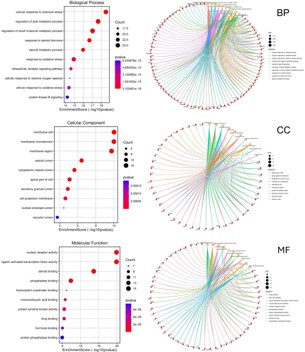
GO includes three parts: Molecular Function (MF), Biological Process (BP), and Cellular Component (CC), and the GO functional annotations include 1862 BP, 80 CC, and 197 MF. During the analysis, the entries of BP, CC, and MF categories were sorted based on the adjusted P-value and target count (Count value), and the top 10 entries in each category were selected. Using these data, bubble plots were constructed to visualize the results, in which the size of the bubbles reflected the concentration trend of the targets, and the shade of the colours (usually red indicates higher significance) was inversely proportional to the corrected P-value, i.e., brighter colours indicated more significant significance. The BP primarily involves the cellular response to chemical stress, regulation of lipid metabolic processes, regulation of small molecule metabolic processes, response to steroid hormones, and response to steroid metabolic processes, among others. MF mainly focuses on nuclear receptor activity, ligand-activated transcription factor activity, steroid binding, phosphatase binding, transcription coactivator binding, etc., and CC mainly focuses on functional positions such as membrane raft, membrane microdomain, membrane region, vesicle lumen, cytoplasmic vesicle lumen, etc. (Figure 1).
KEGG pathway enrichment analysis:
There were 138 pathways in KEGG pathway enrichment analysis. According to the sorting of corrected P-value and Count value, 10 pathways with significant differences were selected and bubble plots were made for visualization, mainly EGFR tyrosine kinase inhibitor resistance, Proteoglycans in cancer, Prostate cancer, Melanoma, Endocrine resistance and other signaling pathways. This result suggests that C. Moutan compounds can work together to produce a therapeutic effect on therapeutically effect diabetes by modulating different biological pathways (Figure 2).
The surgery duration was 262 minutes, with a blood loss of 125 ml, and the time to pass gas was 3 days. The patient was given sugar water on the first day after surgery and solid food on the second day after surgery. After 7 days in the hospital, with no complications, the patient was discharged home. The patient was re-examined after 1 month with stable clinical symptoms. Three months after the first surgery, the patient was hospitalized to close the ileostomy. The patient was discharged from the hospital 5 days after the surgery. Regular follow-up every 3 months and no abnormal signs within 1 year.

Target protein screening and compound-target pathway network construction
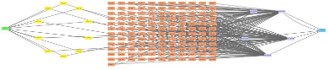
Firstly, the compound target-protein interaction network was constructed based on the 133 overlapping targets and the associated 5 drugs and the top 10 key pathways, containing 150 nodes and 231 edges, where the purple box represents the active molecules, the blue box represents the drugs, the yellow box represents the pathways, the green box represents the diseases and the orange box represents the target proteins (Figure 3). The top 5 active compounds screened based on topological parameters were AKT1 (serine/threonine protein kinase AKT), PPARG (peroxisome proliferator-activated receptor gamma), EGFR (epidermal growth factor receptor erbB1), SRC (tyrosine protein kinase SRC) and CASP3 (caspase-3) (Table 2).
| Target protein | Betweenness centrality | Closeness centrality | Degree |
|---|---|---|---|
| AKT1 | 0.102 | 0.721 | 82 |
| PPARG | 0.114 | 0.698 | 75 |
| EGFR | 0.058 | 0.66 | 65 |
| SRC | 0.119 | 0.66 | 64 |
| CASP3 | 0.027 | 0.644 | 61 |
| ESR1 | 0.052 | 0.641 | 59 |
| HSP90AA1 | 0.038 | 0.632 | 57 |
| MAPK3 | 0.034 | 0.626 | 56 |
| PTGS2 | 0.043 | 0.626 | 54 |
| MMP9 | 0.026 | 0.623 | 54 |
PPI network construction and analysis
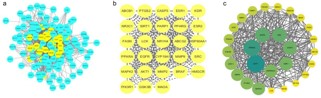
A Protein-Protein Interaction (PPI) network was constructed using 133 screened diabetes-related target proteins, containing 130 interacting nodes (proteins) and 1267 interacting edges. By ranking the degree values, the five core targets with the highest connectivity in the network were identified in this study. The degree values were, in descending order, AKT1, PPARG, EGFR, SRC and CASP3, which was consistent with the order of the results in Table 2, suggesting that these proteins are the potential core targets of oyster pairs for treating of DM (Figure 4).
In insulin signaling, the PI3K/AKT/FoxO1 axis is a key pathway in the regulation of glucose homeostasis [12]. PPARG, as a member of the nuclear hormone receptor superfamily, not only plays a key role in the differentiation and metabolic regulation of adipocytes but is also an essential molecule for adipose tissue differentiation, involved in energy metabolism and adipogenesis and differentiation in vivo, as well as in the regulation of blood glucose levels [13,14]. The regulatory function of SRC proteins may involve the MAPK pathway, in which the SRC-activated Ras/Raf/MEK/ERK signaling chain plays a positive role in accelerating the recovery of granulation tissue after surgery in patients with diabetic foot disease [15].
Validation of molecular docking
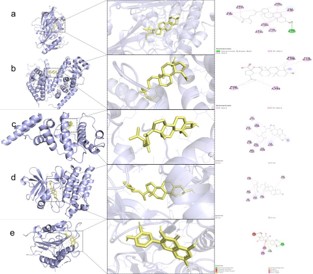
Based on the results of GO and KEGG analyses, AKT1, PPARG, EGFR, SRC & CASP3 were selected as targets for molecular docking in this study (Figure 5). The results showed that the free energy of binding of AKTI to sitosterol ligand was -11.0 Kcal/mol, the free energy of binding of PPARG to Mairin ligand was -8.7 Kcal/ mol, the free energy of binding of EGFR to sitosterol ligand was
-8.0 Kcal/mol and the free energy of binding of SRC to sitosterol ligand was -9.0 Kcal/mol. The free energy of binding of EGFR to sitosterol ligand was -8.0 Kcal/mol, that of SRC to sitosterol ligand was -9.5 Kcal/mol and that of CASP3 to quercetin ligand was -6.7 Kcal/mol. The docking results demonstrated strong interactions between these ligands and the target proteins, with binding free energies below -5 Kcal/mol, thereby confirming the reliability of the target proteins identified through bioinformatics analysis [16]. These results provide a theoretical basis for the potential application of the active components of C. Moutan in the treatment of DM.
In the present study, seven of the 55 active components of C. Moutan were selected for in-depth investigation. By using a network pharmacology approach, the study integrated the information from Swiss Target Prediction, TCMSP and Genecard databases and identified 133 human target proteins related to diabetes treatment, and the functions of these target proteins and the signaling pathways involved were analyzed in detail. The study also confirmed the binding potential of compounds such as sterol, butyric acid terpenes and quercetin to target proteins through molecular docking experiments, thus providing a scientific basis for in-depth investigation of the application and mechanism of action of C. moudan in DM treatment.